OFFSET WINDVANE MOUNT?
- I have a centrally-mounted stern ladder! Some of your competitors say that off center mounting is OK.
Can the windvane be mounted off center?
The concept of using an offset mount for windvanes is tempting for some sailors, especially if they have a swim ladder.
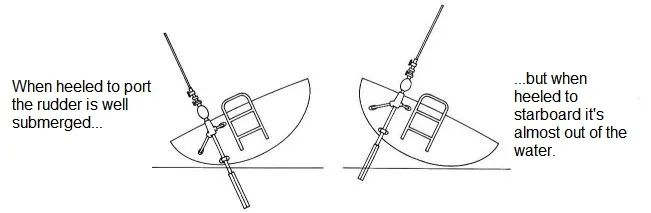
However, it's important to note that this approach is not recommended, unless you're only talking about a few inches or
if you have a multi-hull. It is strongly advised that the windvane, regardless of the manufacturer, is installed on the boat's centerline.
This is because the laws of physics apply to every self-steering windvane, and off-center mounting can cause problems.
When sailing on a reach or upwind, most boats heel significantly, and with an off-center mounting, the paddle could be too deep on
one tack and completely out of the water on the other tack if the boat is pitching in heavy weather - which could lead to disaster.
CAN I USE A SOUTH ATLANTIC SELF STEERING ON A CATAMARAN?
I've seen articles that state that a windvane won't work on one!
In the past, it was commonly believed that wind vanes could not function on catamarans.
However, this belief overlooked the fact that wind vanes can fail to work on any racing boat, whether it is a mono-hull
or a multi-hull, when the boat is capable of achieving speeds that cause the apparent wind to fall near zero. On the other hand,
cruising catamarans, even the fast ones, usually do not achieve such speeds, making them ideal for using wind vanes. Additionally,
catamarans have the advantage of being more flexible in terms of wind vane placement. While the standard position for wind vanes on
a boat centerline can still be used by fitting the wind vane on the after edge of the bridge deck, mounting a wind vane off the boat
centerline is also possible on a catamaran, as catamarans do not heel to any appreciable amount.
CUSTOMER SERVICE
- What service can I expect after I buy a windvane?
If you need any assistance regarding windvane orders or have any self-steering questions, simply send us an email.
We have almost 40 years of experience in shipping parts and complete windvane orders, and we offer a three-year warranty
covering both parts and workmanship. Additionally, we provide free advice to windvane owners and anyone seeking self-steering guidance.
We will respond to your email as soon as possible.
OPERATING LINE SETUP
- I do not want lines in the cockpit. It´s that possible?
The South Atlantic S 600 work very well and have no lines. We strongly recommend
The South Atlantic S 600 when your boat steers over a hydraulic wheel.
LEARNING TO USE A SOUTH ATLANTIC SELF STEERING
- How long does it take to learn how to use a windvane?
When using a windvane, there might be some subtleties and refinements to be learned,
but if you're already comfortable with handling your boat, the basics are simple.
Here are the initial steps:
1. Get your boat onto your desired course.
2. Use a reasonably balanced sail plan to minimize excessive weather or lee helm.
3. Orient the air vane to match the apparent wind direction.
4. Lower the paddle into the water.
5. Engage the wheel or tiller adapter. That's it to get started! The nuances will come with experience over time.
That's all there is to it.
CENTER-COCKPIT BOATS
- I have a center-cockpit boat. I've been told that
I can't run the operating lines that far forward. What can I do?
If good-quality low-friction blocks are used and some thought is given to the run of the operating lines,
quite large center-cockpit boats can be fitted with wind vanes.
However we recommend The South Atlantic S 600 when your boat have center cockpit or steers over a hydraulic wheel.
WE HAVE A KETCH WITH LOW MIZZEN BOOM THAT EXTENDS AFT OF THE TRANSOM. Can we use a South Atlantic ?
Yes. Please contact our us for a custom design solution that may include a special mast tube, special air vanes,
or modified mounting platforms or other components.
HYDRAULIC STEERING: We have hydraulic steering. Can we use the South Atlantic ?
The South Atlantic S 600 when your boat steers over a hydraulic wheel.
HOW DOES THE SOUTH ATLANTIC WIND VANE compare to an automatic pilot? Can I use both?
This is a common question! Here's an insightful statistic: Almost 100% of sailors who purchase a South Atlantic windvane already have an automatic pilot onboard!.
And the usage pattern is clear: The windvane is used 90% of the time AFTER both systems have been installed!.
Why? Because when your ship is sailing with sails set, the wind steers it better!.
A windvane constantly adjusts steering based on the actual
wind direction, providing optimal sail trim and course-holding relative to the wind, which is exactly what you want
when sailing.
Autopilots steer to a compass course, which can be less efficient and comfortable when the wind shifts.
You can certainly use both systems, switching between them as needed for motoring or specific sailing conditions.
WHAT KIND OF CUSTOMER AND WARRANTY DO YOU OFFER?
We stand behind our product with a three-year warranty covering parts and workmanship on all our windvanes.
With almost 40 years of experience shipping parts and complete windvane systems worldwide, you can trust our logistics.
If you have questions or need support, simply send us an email, and we promise to get back to you as soon as possible.
We also provide free advice to both current South Atlantic owners and anyone else with questions about
self-steering systems.